




AI travel assistants: what actually works (and what the leading companies already know)
Discover what AI travel assistants can actually do, how leading airlines and OTAs are using them today, and what it takes to build one that delivers real results.

Picture the last time travel went sideways for you. Flight delayed three hours. App spinning. Phone hold music playing. A chatbot telling you to “visit our FAQ.”
Now picture a different version: a message arrives before you even check the departures board. Your flight is delayed, but you have already been rebooked on the next departure, your seat preference is preserved, and your hotel has been notified. The message came from an AI. No human was involved. The whole thing took under 90 seconds.
That is not a product demo scenario. It is what several of the world’s largest airlines are doing right now. And the gap between companies that have built this capability and those still running rule-based chatbots is widening fast.
This post is written for the people making platform decisions in travel: CMOs, CTOs, and digital transformation leads who need a clear view of what AI travel assistants can actually do, what separates the generations of technology, and what it takes to build something that delivers real results.
The travel customer experience is broken (and everyone knows it)
Travel has an information problem, a timing problem, and a personalization problem. Usually all three at once.
Think about what a traveler goes through before booking a single trip. Research across half a dozen sites. Comparison tabs multiplying endlessly. Questions that need a human to answer, being routed to a bot that only handles three topics. Then the booking itself, which might span three different interfaces if they want a flight, hotel, and car together.
The expectation today is that brands respond instantly, in any language, on any channel, at 2am on a Saturday. That bar is set by the best consumer apps in the world, and travel brands are being measured against it whether they like it or not.
When something goes wrong, and in travel it is always a matter of when not if, the experience tends to collapse entirely. Delays, cancellations, and rebooking requests flood contact centers precisely when agents are most stretched. The most stressed passengers get the longest hold times. That is the opposite of what the moment requires.
The cost lands on the business just as hard. IATA has estimated that EU261 compensation requirements alone cost European airlines €5 billion a year in mandatory payouts for delays and cancellations, on top of the goodwill gestures and agent handling time that every disruption generates.
EU261 and similar regulations mean missed connections and cancellations carry mandatory compensation obligations, with airlines paying out billions annually. A single viral thread about a bad delay experience can move review scores in ways that affect corporate travel contract renewals and OTA ranking algorithms. For decision-makers, the broken experience is not just a satisfaction problem. It is a direct cost line.
And throughout all of it, travel brands are sitting on enormous amounts of customer data: loyalty histories, preference signals, past behavior. Rarely is any of it used in real time. The result is generic service delivered to customers who have been loyal for years.
AI travel assistants vs chatbots vs agents: what is actually different?
These terms get used interchangeably, and they describe very different things. The distinction matters enormously for what you can build and what ROI you can expect.
Rule-based chatbots
- Fixed scripts
- Keyword matching
- Routes to human
- Cannot adapt
Conversational AI
- Understands natural language
- Multi-run context
- Handles common queries
- Reduces contact
- Center load
Agentic AI
- Executes full workflows
- Connects to live systems
- Resolves end-to-end
- Escalates with full context
Rule-based chatbots
The first generation of travel chatbots were decision trees with a friendly interface. They answered a fixed set of pre-written questions and routed everything else to a human. For narrow, predictable queries, they worked fine. The moment a traveler asked something slightly off-script, they hit a wall.
Many travel companies still run these. They handle volume at the top of the funnel but cannot adapt or learn. A traveler asking three related questions at once will get a frustrating experience.
Conversational AI
The step up is natural language understanding: systems that read intent rather than keywords, hold context across a multi-turn conversation, and handle the natural variation in how people ask the same question. A well-built conversational AI chatbot handles flight status queries, booking modifications, loyalty inquiries, and basic itinerary help without human involvement.
This is where the clearest short-term ROI sits for most travel businesses: deflecting contact center volume while keeping response quality consistent.
Agentic AI: the real differentiator
Agentic AI is categorically different. It does not just respond to queries. It executes complete workflows end to end, connecting to live systems and resolving problems autonomously without a human required for each step.
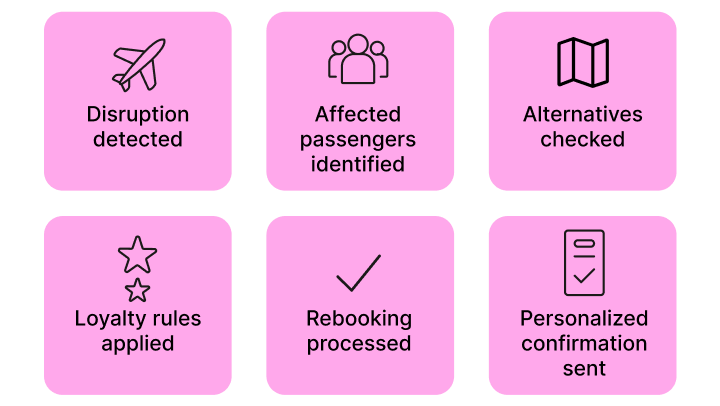
In travel, that means an AI agent can detect a disruption, identify every affected passenger, check alternative routes, apply loyalty tier rules, process rebookings, update passenger profiles, and send personalized confirmations across each traveler’s preferred channel. No human touches the case unless it genuinely needs human judgment, at which point it escalates with full context already attached.
The distinction changes the cost model, the customer experience, and the data quality all at once. This is where the leading travel companies are investing right now.
The business case is already proven at scale:
Wizz Air‘s agentic virtual assistant handles over 250,000 disruption queries per month and is tracking toward a 90% automation rate.
IndiGo reported a 75% reduction in agent workload after deploying conversational AI across 10 languages.
Accor‘s AI deployment lifted CSAT from 67% to 89% across four properties.
For a travel business handling tens of thousands of interactions a day, those percentages translate directly into reduced cost-per-contact, faster resolution, and measurable loyalty improvement. That is the number to anchor any build-vs-buy discussion on.
Real companies, real results: what good looks like
The best way to understand what AI travel assistants actually deliver is to look at the specific problem each company faced before they built something. The results follow from the problem being real.
Lufthansa Group and IndiGo
Problem: When disruptions hit, contact centers get buried. Thousands of passengers asking the same questions across the website, app, and messaging platforms at the same time, with no scalable way to handle it. For airlines, this is not a bad day. It is every operational disruption.
Lufthansa Group built an AI layer that now handles around 16 million conversations per year, with peak days reaching 375,000 interactions. The AI covers rebooking, refunds, cancellations, and flight status across multiple channels simultaneously. Human agents handle complex cases. Everything routine goes through AI. The result is a support operation that absorbs spikes that would have overwhelmed any human team.
IndiGo took a similar approach and reported a 75% reduction in agent workload, with AI handling queries across 10 languages from a single deployment. For carriers operating across many markets, one AI serving customers in their own language on any channel beats building separate support infrastructure for each region.
Wizz Air and United Airlines
Problem: A flight gets cancelled. The passenger finds out at the gate. By the time they reach an agent, the best rebooking option is already gone. This is the scenario that generates the most complaints, the worst reviews, and the most lasting damage to loyalty.
Wizz Air rebuilt their virtual assistant Amelia specifically around disruption. The AI now handles over 250,000 queries per month and, since mid-2024, proactively calls passengers when a cancellation occurs, offering rebooking and refund options before they even reach the airport. The system is tracking toward a 90% automation rate. Passengers get a resolution. Agents get to focus on cases that genuinely need them.
United Airlines tackled the same emotionally charged moment from a different angle: the delay notification itself. Rather than sending a generic “your flight is delayed” message, they used AI to write individualized explanations for each delay, drawing on the specific operational reason honestly. They called it “Every Flight Has a Story.” CSAT improved by 6%, and personalized updates scaled from 15% of flights to 50%. Writing thousands of individual delay explanations per day is not something a human team can do. AI makes it routine.
KLM and Booking.com
Problem: Building a great app is not enough if customers never open it. Travelers live in messaging apps, and asking them to switch channels to get help creates friction that costs bookings and satisfaction scores.
KLM’s BlueBot handles over 1 million conversations per month across 13 languages, entirely within social and messaging channels. The number that tells the real story: 15% of KLM boarding passes are now issued directly through Facebook Messenger. A customer asks a question, the AI answers it, the boarding pass arrives in the same thread. No app switch, no login, no friction. NPS is running 5 points above target.
Booking.com brought conversational search and AI-powered property Q&A into its booking flow. Connected Trip transactions, where one booking covers flights, hotels, and car rental together, grew 40% year on year in Q3 2024. Making complex multi-product booking feel like a simple conversation drove that growth directly.
Accor
Problem: In hospitality, dissatisfied guests rarely escalate at the property. They check out, go home, and leave a review. By the time the feedback arrives, there is nothing to be done. The fix is making it easy for guests to get help in the moment, on whatever channel they prefer.
Accor deployed a generative AI chatbot across four properties and saw CSAT improve from 67% to 89%. A 22-point swing. In a sector where review scores directly affect occupancy rates and corporate travel contracts, that kind of shift compounds significantly over time.
Expedia
Problem: Anyone who has organised a group trip knows the feeling: a single WhatsApp thread, fifteen opinions, and a booking spread across three websites. When something changes, coordinating the response is often harder than the original planning.
Expedia’s Romie assistant lives inside the group chat where the planning is already happening. It integrates with SMS threads, email, and the Expedia app, handling planning, booking, and real-time disruption management in the same conversation. When the itinerary changes, the AI is already there. No one needs to go anywhere else.
AI travel assistants in action: How AirAsia delivers at scale with Infobip
For a low-cost carrier operating at scale, every flight change triggers a cascade of communications: advisories, rebooking options, itinerary updates, security verifications. At volume, that is not a customer service problem. It is an infrastructure problem.
These messages don’t go in hundreds or two hundreds, it goes for thousands. And with Infobip’s platform, we see that it’s very stable, it’s able to sustain the load and deliver the message in a timely manner.

Maurice Robin
Head of Preflight, AirAsia
AirAsia solved it by treating communication as a core operational system. Working with Infobip, the airline built an AI-powered omnichannel setup spanning SMS, email, and voice that achieves a 90% delivery rate across notifications. The NPS sits at 50. The travel industry average is 26.
90% notification delivery rate across SMS, email, and voice
NPS of 50; nearly double the travel industry average of 26
What it actually takes to build AI travel assistants that work
The companies above did not get those results by adding a chatbot to a webpage. A few architectural decisions separate deployments that deliver from those that disappoint.
The data layer is the foundation. AI is only as good as the data it runs on. If booking history is in one system, loyalty data in another, and support conversations in a third, no AI can produce genuinely contextual responses. A unified customer profile capturing behavior, preferences, conversation history, and sentiment signals across every channel is what turns generic AI output into personalized service.
Channels are not an afterthought. Travelers move between websites, WhatsApp, SMS, and voice calls within a single journey.
An AI that only lives on one channel has no memory of what happened on the others. Omnichannel deployment with context preserved across touchpoints is what makes the experience feel like one relationship rather than several disconnected ones.
The handover to humans matters as much as the AI itself. When a case genuinely needs a human agent, the handover should carry everything: customer history, what the AI tried, where things stand. A customer repeating their whole situation to a human after already explaining it to an AI is one of the most reliable drivers of poor satisfaction scores.
Scale is a design requirement, not a nice-to-have. Travel demand is seasonal and disruptions are unpredictable by definition. The platform needs to absorb spikes without degrading, without an engineering intervention every time volume surges unexpectedly.
How Infobip’s AgentOS is built for travel
For travel brands evaluating platforms, Infobip’s AgentOS is designed around exactly those requirements. It is not a standalone chatbot tool. It is an AI-native orchestration platform for enterprises deploying AI agents at scale, with unified customer data and coordinated AI and human agents across every channel in one place.
The data layer is a conversational CDP that builds persistent customer profiles from every interaction, capturing conversation history, sentiment, behavioral patterns, and engagement data in real time. The AI Agents Studio lets teams build agents that connect to live data sources, execute multi-step workflows, and handle the rebooking, disruption management, and personalization scenarios described above. No-code, low-code, and pro-code options (Python, LangGraph, AutoGen) are all available.
For businesses handling payment data, loyalty accounts, and travel documents: AgentOS holds SOC2, ISO27001, and GDPR certifications, with AES-256 encryption at rest and a 99.95% uptime SLA. Native integrations cover Salesforce, HubSpot, Microsoft, Oracle, and Adobe.
Questions worth asking when evaluating AI travel assistant platforms
When comparing options, these questions tend to surface the real differences between enterprise-ready platforms and point solutions that hit a ceiling quickly.
- On channels: Does the platform natively handle the channels your customers use, or connect through third-party integrations? Native means unified data. Integrations mean gaps.
- On agentic AI: Can it build agents that execute multi-step workflows autonomously, or is it limited to scripted conversation flows? The difference is between AI that routes and AI that resolves.
- On data: Can the AI access a unified customer profile in real time during an interaction? Batch data and siloed systems produce generic responses.
- On handover: What does escalation look like for both the agent and the customer? Full context carried over, or does the customer start again from scratch?
- On security: Who owns the security layer? It matters considerably when handling passport data and payment credentials.
- On deployment: Can non-technical teams build and iterate on AI flows, or does every change require engineering time?
The bottom line on AI travel assistants
Lufthansa handles 16 million AI conversations a year. Wizz Air is tracking toward 90% automation for disruptions. Accor improved CSAT by 22 points. Booking.com drove 40% growth in multi-product transactions. AirAsia runs an NPS of 50 in a market where 26 is average.
Those results come from treating AI as infrastructure rather than a feature: unified data, real omnichannel reach, capable agentic workflows, and a human layer that works with AI rather than separately from it.